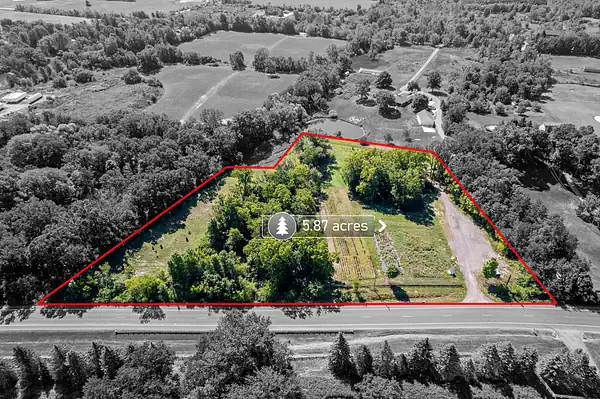
A buyer I worked with found forty acres with a creek running through it, priced noticeably under the parcels around it. He wanted to put a house toward the back where the ground rises. The reason for the price showed up early in the title work. The only way onto the property was a gravel two track that crossed a neighbor’s field, and nothing recorded anywhere said he had the right to use it. The seller had driven it for decades because the neighbor never objected. That is not access. That is a favor, and favors do not transfer with the deed.
Access is the first thing I look at on any land deal, before soils, before zoning, before I think about where a house would sit. A parcel with no legal way in is not a building site. It is a piece of ground you can own and look at.
Access is a legal question, not a physical one
This trips people up constantly. You can drive onto a parcel, park, walk it, and still not have access in the sense that matters. What matters is whether there is a recorded right to cross whatever you are crossing, and whether that right runs with the land rather than with the person who happens to own it today.
The clean version is frontage on a public road that is actually accepted and maintained by the town, village or county. If the parcel touches a public right of way and the road authority will permit a driveway onto it, the access question is mostly settled. Everything short of that needs to be read carefully.
The arrangements you will run into
| What it is | What to understand about it |
|---|---|
| Public road frontage | Strongest position. Still confirm the road is publicly accepted and that a driveway permit can be issued where you want the entrance. |
| Recorded easement | A written, recorded right to cross someone else’s land. Read the actual document. Width, location and permitted use are all spelled out, or sometimes badly spelled out. |
| Shared driveway | Workable, but ask who maintains it, who plows it, and whether that is written down or a handshake. |
| Prescriptive or implied claims | Based on long use rather than a document. These are legal arguments, not facts, and they get resolved by attorneys and courts, not by me. |
| Nothing recorded | Landlocked. The seller may be able to obtain an easement from a neighbor before closing. That is a negotiation with a third party who has no obligation to say yes. |
Read the easement, not the summary of it
When an easement exists, the document itself is where the real information is. A fifteen foot easement is not wide enough for a driveway plus utility trenching in most cases. An easement described as being for agricultural access may not cover hauling in a modular home or running power. An easement that says “existing driveway” and an easement that describes a surveyed strip are two very different things once a neighbor decides to be difficult.
If the only thing standing between you and your future driveway is a neighbor’s goodwill, you do not have a driveway. You have a conversation that has gone well so far.
I read these documents on behalf of buyers so I know what we are dealing with, but interpreting an ambiguous easement is attorney work. When the language is unclear or the width looks tight, that goes to a real estate attorney before we remove a contingency, not after.
Easements that run the other direction
The parcel you buy may also carry easements that burden it. Utility corridors, drainage easements, a neighbor’s right to cross your land to reach a field, an old pipeline or transmission route. None of these are automatically a problem. They matter because they can sit exactly where you wanted the house, the shed or the septic field. A buildable eighty acre parcel with a utility corridor down the middle is still buildable, just not everywhere on it.
What to do before you write the offer
- Pull the parcel on the county land records and look at what the mapping shows for frontage and adjoining right of way.
- Ask the listing side for any recorded easements, prior surveys, certified survey maps and driveway permits they have. Sellers often have more paper than they volunteer.
- Call the road authority that controls the frontage, whether that is the town, the village, the city or the county highway department, and ask what a driveway there would require. That office gives the answer, not me and not the seller.
- Order a title commitment early and read the exceptions. Easements and restrictions live in that section.
- If anything is unclear on the ground, get a survey. A surveyor is the only person who can tell you where the lines and easement strips actually are.
- Write contingencies that match the risk. If access depends on something being obtained or clarified, the offer should say so and give us a way out.
I will say plainly that some of these deals are not worth doing. A cheap landlocked parcel with a cooperative neighbor today can become an expensive problem when that neighbor sells. I would rather tell you that in week one than watch you find out in year three.
If you are looking at land right now
Send me the parcel and I will start with the access question before anything else, pull what the county has on record, make the call to the road authority, and tell you what I think you are actually buying. If it looks like it needs a surveyor or an attorney, I will say so and help you line that up. Broker compensation is not set by law and is fully negotiable. We put the arrangement in writing before we tour anything.