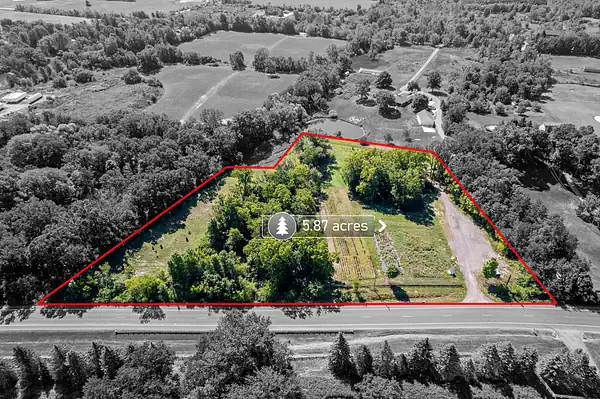
A buyer called me last spring about ten acres outside Mukwonago. Good road frontage, a gentle roll to the ground, a stand of oaks along the back line. He wanted to know if he could close in thirty days and break ground in June. The honest answer was that nobody could tell him yet, because nothing had been dug.
Land without municipal sewer and water has a sequence to it, and the sequence does not care about your timeline. Here is how it actually runs in southeastern Wisconsin, and who you are calling at each step.
The septic question comes first
If a parcel is not on a municipal sewer line, the house needs a private onsite wastewater treatment system. Whether the land can support one, and what kind, is decided by a soil evaluation. A licensed soil tester digs test pits, logs the soil horizons, and reports the depth to groundwater and to any restrictive layer like bedrock or dense clay.
That report drives everything downstream. Deep, well drained soil may allow a conventional in-ground system. Shallow soil or a high water table pushes you toward a mound or at-grade system, which costs more and takes up more of the lot. Poor results can mean no approvable system in the spot you wanted the house, and sometimes not anywhere on the parcel.
If you do only one thing before you release your contingencies on raw land, make it a soil evaluation by a licensed soil tester. Everything else is cheaper to find out late.
I am not a soil tester and I do not read the pits. What I do is make sure your offer buys you the time and the access to get it done, and that you have a tester lined up before the clock starts running.
Water is a separate question
A septic approval tells you nothing about water. Most rural parcels here need a private well, and that is a different contractor and a different unknown. Depth varies a lot across the region, and so does what you hit on the way down. A well driller who works your township regularly can tell you what neighboring wells ran, and the county health or environmental health office keeps well construction records you can ask about.
Two things worth knowing before you commit. The well and the septic have to sit a required distance apart, and from the house and the lot lines, so a tight parcel can get complicated fast. And water quality is its own test after the well goes in, separate from whether water is there at all.
Zoning and setbacks decide where the house can sit
Soil and water tell you what is possible. Zoning tells you what is allowed. The parcel sits in a zoning district with a minimum lot size, minimum road frontage, and front, side and rear setbacks. If any part of the land is mapped as wetland, floodplain or shoreland, that layer adds its own restrictions on top.
Call the zoning administrator for the town, village or city the parcel sits in, unless the county handles zoning there. Ask what district it is, what the setbacks are, and whether a residence is a permitted use or needs a conditional use permit. They answer that question all day and the answer is free.
The order to do it in
- Confirm zoning and permitted use with the zoning office before you write anything.
- Write the offer with real contingency time for soil testing, and with permission to enter and dig.
- Get the soil evaluation. Have the tester tell you what system type the results point to.
- Talk to a well driller about depth and cost in that township.
- Get a survey if the boundaries, the acreage or the access are not clear from the deed.
- Verify legal access to a public road, in writing, including any shared driveway or easement.
- Then price the build, with the site work and utilities the testing just revealed.
Who answers what
| Question | Who answers it |
|---|---|
| Can this land support a septic system, and which kind | Licensed soil tester, then the county or state permitting office |
| How deep is water here and what will a well cost | Licensed well driller, plus county well records |
| What can I build and where can I put it | Zoning administrator for that municipality |
| Where exactly are the boundaries | Licensed land surveyor |
| Is any of this wetland or floodplain | Zoning office and the state wetland and floodplain mapping |
| Will a lender finance it, and on what terms | A lender that does land and construction loans |
What this means for your offer
A land offer without a real testing contingency is a bet. Thirty days is usually not enough for soil work in a wet spring, when testers are backed up and the pits fill with water. Build in the time, write in the right to enter and dig, and be specific about what result lets you walk.
Sellers of raw land are often fine with this once it is explained. What they do not like is a buyer who goes quiet for six weeks and then asks for an extension. One more thing: walk the parcel in spring. Ground that looks fine in August can hold standing water in April, and that is the ground your soil tester has to work with.
If you are looking at land
If you have a parcel in mind in southeastern Wisconsin, send me the address or the tax key and I will pull what is public on it, tell you which zoning office to call, and put you in touch with soil testers and well drillers who work that township. If the testing comes back bad I will tell you to walk, and I have told people that before. Broker compensation is not set by law and is fully negotiable. We put the arrangement in writing before we tour anything.