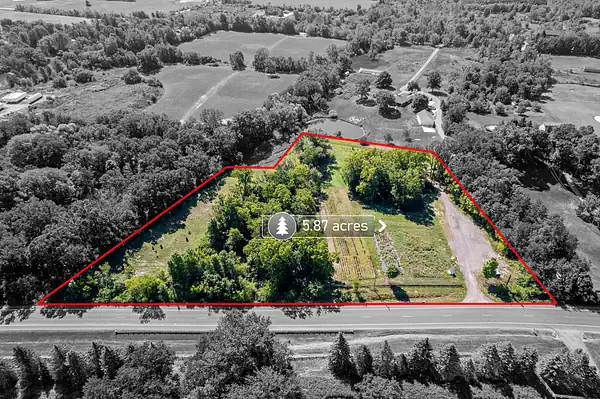
I get a version of this call every few weeks. Someone owns ten acres, or is looking at a listing with ten acres, and wants to know if they can carve off a piece. Sometimes to build on. Sometimes to sell and recover part of what they paid.
The honest answer is that acreage alone tells you almost nothing. I have seen three acres divide cleanly and forty acres that could not be touched. What matters is a stack of rules that sit on top of each other, and they have to be checked in order.
Zoning comes first
Every parcel has a zoning district, and that district sets a minimum lot size. If you are in a district with a five acre minimum and you own eight, you do not have a split. You have one lot and three extra acres.
Zoning also sets minimum road frontage. This is the rule that quietly kills more splits than lot size does. A long narrow parcel might have plenty of acreage and only enough frontage for one driveway. Every lot you create generally needs its own legal access to a public road, and if the geometry does not allow it, the acreage does not matter.
Zoning can be changed, and in some cases rezoning is a reasonable path. But it is a public process with a hearing, neighbors, and no guaranteed outcome. Treat it as a project, not a formality.
Then the division rules
Wisconsin draws a line between a minor division and a full subdivision plat, and the line is usually drawn at the number of lots created within a set period of time. Below that threshold you are typically looking at a certified survey map, which is a surveyed document recorded with the county. Above it you are into a plat, which is a longer and more expensive process with preliminary and final approvals.
Both the municipality and the county generally have a say, and some parcels fall under additional review depending on location. The specific thresholds and the review path vary by municipality, so this is a question for the local planning or zoning office, not something to assume from a neighboring town’s rules.
The cheapest phone call in this whole process is the one to the municipal zoning office. They will usually tell you in ten minutes what would otherwise cost you a month to find out.
Then whether the new lot is actually buildable
This is the step people skip, and it is where the money is.
A lot can be legal to create and still be impractical to build on. If the parcel is outside a sewer service area, each new lot generally needs a septic system, and that means soil testing. If the soils will not support a conventional system, you are into a mound system at a meaningfully higher cost. If the soils will not support anything, you do not have a buildable lot.
Wetlands, floodplain, shoreland zoning near a lake or river, and steep slopes all shrink the usable area further. A ten acre parcel with six acres of wetland is a four acre parcel for building purposes, and the wetland boundary is determined by a delineation, not by looking at it.
Then access again: a driveway permit, a culvert, and in some cases a county highway or state permit if the frontage is on a bigger road.
The order I recommend
- Call the municipal zoning office. Confirm the district, the minimum lot size and the frontage requirement.
- Ask what division process applies for the number of lots you want, and who reviews it.
- Confirm sewer and water availability, or plan on soil testing.
- Check the maps for wetland, floodplain and shoreland overlays.
- Bring in a surveyor to see whether the geometry actually works on the ground.
- Only then price it out.
Done in that order, you find out early and cheaply. Done backwards, you pay a surveyor to tell you something the zoning office would have told you for free.
What a split is worth
When it works, the value is real. An extra buildable lot in a desirable school district is worth a great deal more than the same acreage attached to an existing home. Some owners split to sell a lot and reduce what they owe. Some split to keep a piece for a family member. Some developers assemble parcels specifically because the split potential is the entire business case.
But the value is in the entitlement, not the dirt. A parcel with approvals in hand is a different asset than a parcel where someone thinks a split might be possible.
I am not a surveyor, a zoning administrator or a soil tester, and nothing here is a legal opinion on a specific property. What I do is know the sequence, know who to call, and tell you honestly when a parcel is not going to work before you spend money finding out. If you are looking at something right now, send me the parcel number and I will start making calls.